
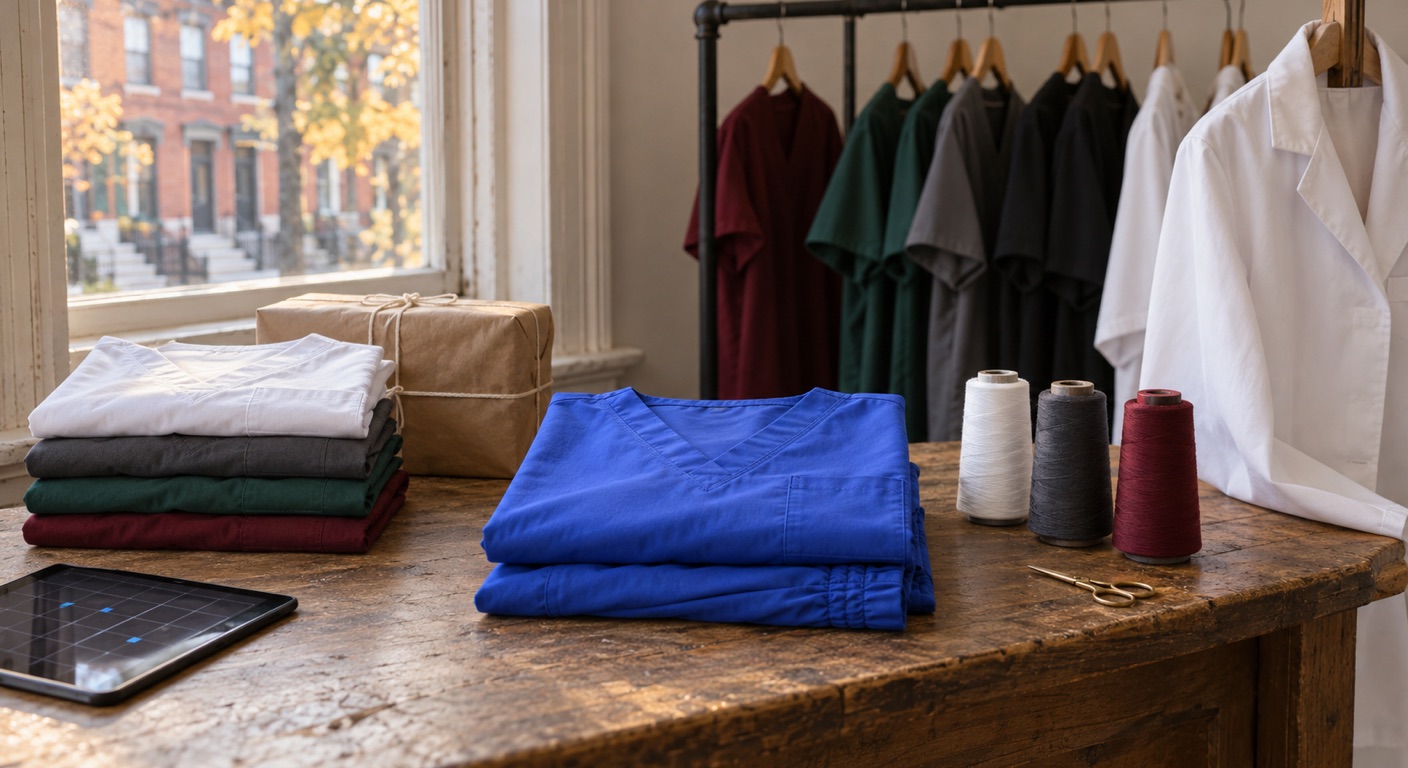
On a Monday in October, the owner of a small uniform shop in a Baltimore rowhouse storefront opens the laptop to three orders. The first is from a nonprofit hospital’s cardiac unit: 38 sets of scrubs in the color the hospital assigns to its nurses, each with the nurse’s first name and credentials embroidered over the pocket. The hospital pays the first $100 of each nurse’s order from its uniform allowance, and each nurse pays the rest, about half of them by card at checkout and the other half through a payroll deduction the hospital has agreed to take. The second is a web order from a travel nurse in Sacramento for two scrub sets that the shop’s product page describes as antimicrobial and fluid-resistant, “protecting you from germs on every shift.” The third is a phone call from a man who wants a Baltimore police shoulder patch for a Halloween costume.
Each of those orders touches a rule the shop’s software almost certainly does not hold. The hospital’s share of the cardiac unit order is exempt from Maryland’s 6% sales tax if the hospital is buying for its own work with its exemption certificate on file; each nurse’s share is that nurse’s purchase, and taxable. The payroll deductions are lawful only against a separate signed authorization from each nurse, and the hospital’s color chart is the reason the scrubs count as a uniform under federal wage rules, so no deduction may push anyone’s pay below the minimum. The embroidered names mean none of the 38 sets can be resold, so the shop has to say before payment that they are final sale. The travel nurse’s order has two problems in one line of product copy. “Protecting you from germs” on a garment treated with an antimicrobial is the kind of claim the EPA says takes it outside the exemption for treated articles, which makes it an unregistered pesticide claim; and if the fluid-resistant finish is made with PFAS, California has banned that in clothing, everyday work uniforms included, since January 2025. And the shoulder patch is something Maryland law says a person may not have without the authority of the Police Commissioner of Baltimore City, whatever the reason.
This article goes through those rules for Baltimore’s uniform stores, scrubs shops, school and public-safety uniform suppliers, and the employers who run uniform programs. It covers who has to pay for scrubs and who washes them, what the words antimicrobial, fluid-resistant and surgical mean on a product page, and how Maryland taxes a uniform depending on who is buying it. Then it looks at what the software costs and what it cannot do, at what 20 uniform businesses in and around Baltimore and 33,312 listings on 70 web stores show a customer or a machine, at how to sell scrubs and uniforms online when one catalog serves both nurses and their employers, and at what we would build. We are a software studio, not lawyers; where a rule is our reading of the text rather than an agency’s or a court’s statement, we say so.
The trade in Baltimore: a hospital town with a handful of uniform shops
Baltimore buys a lot of scrubs. In the Census Bureau’s American Community Survey for 2020 to 2024, 19,092 Baltimore City residents worked in health care practitioner and technical jobs and 11,260 in health care support, together 11.0% of the City’s employed residents; in Baltimore County the figures were 32,323 and 14,205, or 10.8%. About four in five of them are women. Counted by where the jobs are rather than where people live, the Baltimore metro area had 238,800 jobs in health care and social assistance in August 2026, up 1.6% in a year in which total employment fell by half a percent, and 71,800 of them in hospitals. The state’s own list of the City’s largest employers reads like a hospital directory: the Johns Hopkins Hospital and Health System with 20,845 employees, the University of Maryland Medical System with 11,450, MedStar with 6,175, Mercy with 5,500, LifeBridge with 5,315, Kennedy Krieger with 2,600 and Saint Agnes with 2,500. In the County, MedStar, GBMC, UM St. Joseph and Sheppard Pratt each employ more than 2,000.
The shops that sell to them are few and small. County Business Patterns, the Census count of businesses with paid employees, files uniform stores and school uniform stores under NAICS 448190, “other clothing stores,” together with bridal, costume and lingerie shops, so even that code overstates the trade. In 2023 it had 25 establishments in Baltimore County, with 220 employees and $5.5 million of payroll, about $25,000 a head, and seven in Baltimore City, five of them with fewer than five employees. The laundries are bigger and sit in the City: eight linen and uniform supply plants with 520 employees and $28.1 million of payroll, five of them industrial launderers that rent work uniforms and three linen suppliers, the code under which the Census files “gown (e.g., doctors, nurses, hospital, beauticians) supply services.” As always with this source, sole proprietors are not counted, and a missing row means the Census suppressed it, not that it is zero.
| Measure | Baltimore City | Baltimore County | Source |
|---|---|---|---|
| Residents in health care practitioner and technical jobs | 19,092 | 32,323 | ACS 2020–2024, C24010 |
| Residents in health care support jobs | 11,260 | 14,205 | ACS 2020–2024, C24010 |
| Share of employed residents in health care occupations | 11.0% | 10.8% | ACS 2020–2024, C24010 |
| Other clothing stores, incl. uniform stores (NAICS 448190) | 7 (5 with under 5 employees) | 25 (220 employees) | CBP 2023 |
| Linen and uniform supply plants (NAICS 81233) | 8 (520 employees) | 4 (135 employees) | CBP 2023 |
| Largest health care employer | Johns Hopkins Hospital and Health System, 20,845 | MedStar, 4,747 | Maryland Commerce, 2025 |
Nationally, the business has split into three models, and each has a public company to show for it. The first sells to the individual. FIGS, the direct-to-consumer scrubs brand, had $631.1 million of revenue in 2025 from 2.92 million active customers at an average order of $120, with scrubwear 80.6% of it, and its annual report states the premise plainly: “The vast majority of medical professionals purchase their own uniforms.” It reports a return rate of about 10% from 2021 through 2025, against the 30% to 40% it cites for apparel bought online, has five stores, none in Maryland, and sells to hospital departments and clinics through a business program it calls FIGS TEAMS. The second model rents. Cintas booked $8.62 billion from uniform rental and facility services in its fiscal year to May 2026 and agreed in March to buy UniFirst for about $5.5 billion; the companies have agreed not to close before December 11, 2026 unless the Federal Trade Commission finishes its review sooner. The third model is the old brands that sell through dealers, and it has had a harder decade: Careismatic, which owns Cherokee Uniforms, Dickies Medical and Healing Hands, went through Chapter 11 in 2024 and came out owned by its lenders.
Baltimore’s biggest hospitals have already chosen national vendors with portals. Johns Hopkins buys its official staff apparel, scrubs included, from two contracted vendors, Standard Textile and Cintas, with the logo on the left chest and the name on the right in Hopkins blue or black thread. A 2021 University of Maryland Medical Center new-hire flyer sends staff to an official Uniform Advantage site to buy navy scrubs with the hospital’s logo at their own expense, and warns that logo tops ordered in error will not be refunded. GBMC in Towson sends new clinical hires to a national chain’s online store that asks for an employee or candidate number, with about three weeks’ shipping, and lists try-on stores in Hanover, Rockville and Landover Hills, none of them in Baltimore City or Baltimore County. That is the opening for a local shop. The thousands of nurses, aides and technicians those systems employ still need a place to try on a size, get a name embroidered by Friday and replace a torn top, and the region’s smaller employers, the clinics, dental offices, nursing homes, home care agencies, schools, security firms and restaurants, need a uniform program without a national contract.
What uniform store software costs, and what the meter counts
A uniform business usually runs three kinds of software at once, and each one is priced by a different meter. There is a point of sale and web store for the people who walk in or order online. There is a company store, or program portal, for the employers it dresses. And there is whatever runs the embroidery and printing, the decoration side of the trade we covered in our print and sign shop post. We read the published price of every product below on October 7, 2026, from each vendor’s own page; Shopify, Stripe and DecoNetwork show prices in euros to our network in Lithuania, so we checked their US prices from a US address. Where a vendor publishes no price, we say so.
| Product | Published price | What the meter counts |
|---|---|---|
| Square for Retail | $0, $49 or $149 a month per location; cards 2.6% + 15¢ in person (lower on paid plans), 3.3% + 30¢ online on the free plan and 2.9% + 30¢ on paid plans | Locations, and every card payment |
| Shopify | $39, $105 or $399 a month ($29, $79 or $299 paid yearly); Plus from $2,300; POS Pro $89 per location; online cards 2.9% + 30¢ on Basic down to 2.25% + 30¢ on Plus, and 0.2% to 2% extra if you use another processor | The plan, store locations, every online payment |
| Lightspeed Retail | $89, $149 or $289 per location a month billed yearly ($109, $179 or $339 monthly), plus $59 for each extra register | Locations and registers |
| OrderMyGear company store | $499 one-time license per store, or $2,499 for unlimited stores; hosting $119 a month (Standard) or $199 (Premium), each including 50 orders a month, “Additional fees may apply”; budgets an add-on with no price shown | Stores, then orders |
| OrderMyGear pop-up store | $1,899 one-time license, 3.95% of each cart, plus card processing at 2.9% + 30¢ | A share of every sale |
| Chipply | $1,000 one time, then a 3.5% fee on product and decoration plus 2.9% + 30¢ card processing, “No ongoing monthly fees” | A share of every sale |
| InkSoft | $314 a month (100 active stores, five users) or $419 (unlimited) | Active stores and users |
| DecoNetwork | $239, $339 or $439 a month, plus a one-time license whose amount the page leaves blank | The plan |
| Printavo merch stores | $109 a month on top of the $244 Standard plan | The plan |
| UniformMarket, Experlogix, SmartScrubs | No published price | Not disclosed; these are the vendors that advertise allowances and payroll deduction |
| UniFirst uniform rental | “about $4-$15 per wearer per week” on average | Wearers, every week |
| Stripe | Cards 2.9% + 30¢; bank debit 0.8%, capped at $5.00; invoicing 0.4% per paid invoice | Every payment |
Credit where it is due. OrderMyGear, the company-store platform most decorators know, publishes a complete price list down to its hourly store-building rate, which almost nobody else in this category does, and its flat hosting fee does not take a cut of an employer’s spending. Square, Shopify and Lightspeed are good, honest tools for the counter and the web store, and for a shop that mostly sells to walk-in nurses and students they are all the software it needs. Shopify has also opened its business-to-business features to every plan: its help center says “you can use Shopify B2B on the Basic, Grow, Advanced, and Shopify Plus plans,” with net terms, purchase order numbers and bank debit included, although below Plus a store can assign “up to 3 active catalogs across all your B2B markets,” which is three employers’ worth of approved items.
The meters still tell you who each product was built for. Take a modest program: a Baltimore employer with 300 staff gives each one a $100 uniform allowance a year, the staff add $20,000 of their own money, and the shop handles 600 orders worth $50,000, or 50 orders a month. On OrderMyGear’s Standard company store that is $499 plus $1,428 of hosting in the first year, and the 50 included orders are exactly enough. On Chipply’s model the platform fee is 3.5% of $50,000, or $1,750 a year after the $1,000 setup, and it rises with every dollar the employer adds to the allowance. InkSoft would be $3,768 a year whatever the program spends. And if every order is paid by card at 2.9% plus 30 cents, the processing alone costs $1,630. Bill the employer’s $30,000 share on one monthly invoice paid by bank debit instead, at 0.8% capped at $5, and card fees fall to the $760 charged on the staff’s own share, a saving of $810 a year on a small program, before anyone has touched the tax.
Then we went looking for the software that does what a uniform program actually needs, and found its absence. Across 91 app-store listings in the business-to-business, wholesale, personalization and returns categories of Shopify, WooCommerce and BigCommerce, not one mentions an allowance or a stipend, not one offers payroll deduction as a way to pay, and not one splits an order’s tax between the employer’s share and the employee’s. Tax exemption, where an app offers it, is all or nothing for a customer or a company. Spending limits exist, in apps such as B2B Company Controls, Merxio and ApproveCart, but none says the limit resets each period, and one of them sums up the gap in its own listing: “Shopify creates companies and catalogs, but doesn’t control how buyers purchase.” Marking personalized items as final sale is a separate app again, Clearance Guard at $2.99 a month, which asks you to “tick ‘Final sale’” on each product. The vendors that do advertise allowances and payroll deduction, such as UniformMarket (“Payroll deduction: Provide the option to deduct order amount from payroll”), Experlogix and SmartScrubs, publish no price at all.
Hospitals that launder their own scrubs buy a different kind of product, and its prices are even harder to find. The dispensing machines that hand out a clean set against a badge and take back the dirty one are quoted privately: the best-known system’s product page says “Request a Quote,” and a Veterans Affairs notice of intent to buy the same service sole-source lists “No period of performance or contract value specified.” Uniform rental companies are slightly more open. UniFirst says a business can expect to pay “about $4-$15 per wearer per week,” and its own page lists 26 kinds of extra charges common in the industry, for lost garments, damage, fuel and the like, which it says can account for as much as 40% of a customer’s annual spend.
Are scrubs PPE? Who has to pay for scrubs, and who washes them
Every uniform shop that sells to a hospital gets asked this, usually by a nurse at the counter and sometimes by the hospital’s own purchasing office, and the honest answer is that it depends on what the scrubs are for. The federal rule that decides it is OSHA’s bloodborne pathogens standard, and it draws the line in one sentence. In 29 CFR 1910.1030(b), personal protective equipment “is specialized clothing or equipment worn by an employee for protection against a hazard. General work clothes (e.g., uniforms, pants, shirts or blouses) not intended to function as protection against a hazard are not considered to be personal protective equipment.”
If a garment is protective equipment, three duties follow, and all of them fall on the employer. Paragraph (d)(3)(i) says the employer “shall provide, at no cost to the employee, appropriate personal protective equipment such as, but not limited to, gloves, gowns, laboratory coats,” and it counts as appropriate only if blood does not pass through to the employee’s work clothes, street clothes or skin. Paragraph (d)(3)(iv) says the employer “shall clean, launder, and dispose of” it at no cost. And OSHA’s enforcement directive, CPL 02-02-069, rules out the shortcut most people would reach for: “Home laundering by employees is not permitted since the standard requires that the laundering be performed by the employer at no cost to the employee.” If the employer launders the gear but charges for it, the directive tells inspectors to cite (d)(3)(iv) anyway.
Ordinary scrubs usually sit on the other side of the line. OSHA has said so in writing more than once. In a 2009 letter of interpretation it wrote that “employees’ uniforms or scrubs which are usually worn in a manner similar to street clothes are generally not intended to be PPE,” and the same directive describes the normal arrangement: scrubs “are usually worn in a manner similar to street clothing, and normally should be covered by appropriate gowns, aprons or laboratory coats when splashes to skin or clothes are reasonably anticipated.” So the typical Baltimore hospital floor runs on two kinds of clothing at once. The scrubs belong to the nurse, who may have bought them at your counter and washes them at home. The isolation gown over them belongs to the hospital, which buys it, launders or discards it, and never lets it leave the unit.
What decides which kind a garment is turns out to be its job, not its name. OSHA’s 1993 letter to the Fraternal Order of Police put it plainly: a uniform “may or may not qualify as PPE,” and if it “is worn, relied upon, and/or functions as a protective garment, the uniform would be covered by the requirements of the standard,” in which case “employees may not wear the uniform home.” Surgical caps are the clearest example of a garment that can be either. In a 2007 letter to a Pennsylvania hospital, OSHA said the primary use of caps in operating rooms is to protect the patient, but that if staff are given caps that are relied on as protection, contaminated caps “must be laundered by the employer at no cost to the employee.”
Here is the part a uniform store should read twice. In October 2015, a maker of fluid-repellent, antimicrobial scrubs and lab coats wrote to OSHA asking whether its “active barrier” garments could count as an engineering control, the category of safeguard that sits above protective clothing. OSHA said no, and added that “an active barrier garment, as you describe, would be considered a form of personal protective equipment (PPE).” Follow that through. A scrub top sold as ordinary clothing is the nurse’s to buy and wash. The same scrub top sold as a barrier against blood and germs, and relied on that way, is protective equipment, which the hospital must pay for, launder and replace. The words on the product page, and the way an employer decides to use what they promise, can move the bill from the employee to the employer.
The broader federal rule on paying for protective equipment, 29 CFR 1910.132(h), adopted in November 2007 and in force since 2008, says the same thing from the other direction. Employers must pay for protective equipment, but not for “everyday clothing, such as long-sleeve shirts, long pants, street shoes, and normal work boots,” and the rule’s preamble adds that “uniforms, caps, or other clothing worn solely to identify a person as an employee would not be considered to be PPE,” and that the same goes for items worn “for product or consumer safety or patient safety and health rather than employee safety and health.” Where blood is involved, a note to the rule says the bloodborne pathogens standard’s own payment language prevails. In Maryland none of this changes: the state runs its own program, MOSH, which has adopted both federal standards by reference, and which, unlike federal OSHA, also covers state and local government employers, so the rules reach a Baltimore City paramedic as well as a private hospital’s nurse.
When a color makes scrubs a uniform, and what a payroll deduction may take
Wage law asks a different question, and a hospital’s color chart answers it. Under the Fair Labor Standards Act the cost of a required uniform is the employer’s business expense, and the Labor Department’s Field Operations Handbook says that “if the wearing of clean uniforms is required by law, by the employer, or by the nature of the work,” the cost of furnishing or maintaining them “may not be imposed upon the employees if to do so would reduce their wages below the minimum wage.” It names “hospital and nursing home personnel” among its examples. The handbook also says where a dress code ends and a uniform begins. An employer that “merely prescribes a general type of ordinary basic street clothing” and permits variation has not imposed a uniform. An employer that prescribes clothing “of a specific or distinctive style, color, or quality” has. A hospital that tells its patient care technicians to wear one shade of scrubs and its nurses another has, by that test, put them in uniforms.
That does not stop the employer from charging for them, as long as the charge leaves the worker at or above the minimum. The Labor Department’s Fact Sheet 16 allows uniform deductions to be spread over several paydays provided none of them takes the employee below the minimum wage or overtime pay in any workweek, and the handbook adds that when an employee had to buy the uniform, reimbursement is due on the regular payday for that week and “may not be spread over the life of the garment.” Employers also may not avoid the cost “by requiring employees to obtain uniforms before starting the job.” Enforcement happens: in September 2023 the department recovered $23,479 in back wages, and the same again in damages, from a Texas employer that had deducted uniform costs from 66 employees’ pay until it fell below the minimum wage.
Maryland adds a paperwork rule of its own. Under Labor and Employment §3-503, an employer may not deduct anything from wages unless a court ordered it, the Commissioner allowed it, another law requires it, or it is “authorized expressly in writing by the employee.” The state’s Division of Labor and Industry applies that to uniforms directly: the cost of a uniform “which bears the name or logo of the employer may be passed on to an employee through a wage deduction,” provided the employee has given a “signed written authorization,” and an employee who does not return a uniform as required may be charged its depreciated value. The division’s deductions page asks for “a separate and distinct statement, signed by the employee, concerning only the deduction and nothing more,” which rules out a clause buried in an onboarding packet.
Put the two together and you get a check that software can make and people forget. Maryland’s minimum wage in Baltimore City and Baltimore County is $15.00 an hour, $22.50 for overtime. The federal test compares a deduction with the federal minimum, which is far lower, and we found no Maryland source saying whether a uniform deduction may take a worker below the state’s $15.00, so the cautious rule is that it never does. Take an environmental services worker paid $15.75 an hour for 40 hours, $630.00 a week. At the state minimum the floor is $600.00, so the most any uniform deduction can take that week is $30.00. A $64 order of two scrub sets has to be spread over at least three workweeks, and taken only against a signed authorization for that purpose. A uniform portal that offers payroll deduction as a payment button without knowing the wage, the hours and the authorization is offering something the hospital’s payroll will have to undo.
Taxes finish the picture. Since 2018 employees have not been able to deduct work clothes they buy themselves, and the July 2025 tax law, Public Law 119-21, section 70110, made that permanent. On the employer side, the IRS says in Publication 5137 that clothing can be excluded from wages only if it is required as a condition of employment and is “not worn or adaptable to general use as ordinary clothing,” that “the accountable plan rules must be met for reimbursements or clothing allowances,” and that if the employer does not require substantiation, “the allowance is taxable as wages.” Whether scrubs pass the ordinary-clothing test is for the employer’s tax advisers. What is not in doubt is that a flat cash scrub allowance in the paycheck is taxed like pay, while an allowance spent through a store that keeps an itemized receipt for every employee at least has the paperwork an accountable plan needs.
As for washing, the federal infection-control guidance does not settle it. The Centers for Disease Control and Prevention’s environmental infection control guideline says that “experts disagree about whether this regulation extends to uniforms and scrub suits that are not contaminated with blood or other potentially infectious material,” and suggests that facilities requiring uniforms “should either make provisions to launder them or provide information to the employee.” Operating rooms usually go further and use facility-laundered scrubs from a dispensing machine, which is why the scrubs a surgical nurse wears in the operating room and the ones bought at your counter are often not the same garments at all.
Antimicrobial, surgical, fluid-resistant: what the words on a scrubs product page mean
Three words do most of the legal work on a scrubs product page, and none of them describes the cloth. Each describes what the seller says the garment does, and each can bring in a different federal agency.
“Antimicrobial” is a pesticide word unless it is about the fabric
Under the federal pesticide law, a product becomes a pesticide that needs an EPA registration if “the person who distributes or sells the substance claims, states, or implies (by labeling or otherwise)” that it works as one (40 CFR 152.15). Garments treated with silver or other antimicrobials are exempt as “treated articles” only if the treatment is registered for that use and is there “to protect the article or substance itself” (40 CFR 152.25(a)). The EPA’s guidance on that exemption, PR Notice 2000-1, names “various types of finished consumer textiles” among the products whose claims often “extend beyond the protection of the article itself,” and it is strict about words. “An unqualified claim of ‘antimicrobial’ activity” is a public health claim, and so are “antibacterial,” “germicidal” and “references in any context to activity against germs.” “Kills pathogenic bacteria,” “provides a germ-resistant surface” and “reduces risk of cross-contamination from bacteria” appear on its list of unacceptable claims; “inhibits the growth of bacterial odors” and “odor-resistant” on the acceptable one.
The notice even reaches layout. Qualifiers must be printed “in type of the same size, style, and color” and given “equal prominence,” and putting pesticidal terms “in product names or elsewhere in the labeling in bolder text than accompanying information may render such qualifications inadequate.” On a web store, that is a statement about product titles, bullet points and badges. The EPA’s current consumer page, updated in May 2026, gives the wording it considers safe: “Antimicrobial properties are built in to inhibit the growth of bacteria that may affect this product. The antimicrobial properties do not protect users or others against bacteria, viruses, germs, or other disease organisms.” The treatments’ own registrations say the same thing. The label of SILVADUR 930, a silver treatment registered for apparel, says it “prevents the growth of bacteria, mold and mildew that may cause unpleasant odors, discoloration, or deterioration of the treated product.” The registered product behind several other treatments, sold under brand names such as HeiQ, Polygiene and Microban, has a blunter label: products made with it “may not make any public health claims relating to antimicrobial activity without first obtaining an EPA registration for the manufactured product.” The registration belongs to the chemical, not the scrub top, which is why “EPA-approved fabric” is never a safe phrase either.
We found no EPA action against a scrubs brand. But the agency acts on words. In 2018 Medline paid $4.93 million over wipes called “Micro-Kill,” because of claims in the product’s marketing and name, and renamed them. ECCO paid $325,000 in 2016 over insoles marked “antimicrobial, antifungal, antibacterial,” and in 2024 the EPA asked Customs to refuse a shipment of “anti-bacterial sport socks” from a British online fashion retailer. Retailers and marketplaces have paid too: Amazon $1.2 million in 2018 and Costco $3.07 million in 2025, over unregistered pesticides they sold. The best-known fight over scrubs claims was between competitors. In Strategic Partners v. FIGS, the owner of Cherokee Uniforms challenged a hangtag that read “ANTIMICROBIAL: Kills bacteria and infection immediately on contact” and a claim that FIGS fabric reduced hospital-acquired infections by 66%. FIGS admitted before trial that it had not registered its scrubs or claims with the EPA or the FDA; in November 2022 a jury found the statements were neither literally false nor misleading, and the case settled in 2023 with no payment either way. The jury was answering a false-advertising question, not the EPA’s. Today FIGS describes its silver treatment as one that “provides odor protection, inhibits bacteria growth, and extends product lifespan,” much closer to the odor and fabric-protection claims the registration allows.
There is a second reason to watch the word, and it comes back to who pays. Recall OSHA’s 2015 letter: a fluid-repellent, antimicrobial “active barrier” garment would be protective equipment. A product page that sells scrubs as protection against germs is inviting the classification that makes the employer buy and launder them.
“Surgical” makes a cap a medical device, and “antimicrobial” raises its class
The FDA’s rule on surgical apparel, 21 CFR 878.4040, covers “surgical caps, hoods, masks, gowns” and then says, in so many words: “Surgical suits and dresses, commonly known as scrub suits, are excluded.” Scrubs are not medical devices, whatever a search result says, and nobody’s scrubs are “FDA approved.” Surgical caps are devices, Class I and exempt from premarket review in their plain form. Add a claim about the fabric and the class changes: the FDA’s product code QBW, “Surgical Apparel With Material Claims,” is Class II and needs a 510(k) clearance, and it covers apparel treated or coated to add “fluid repellency, soil retention, or antimicrobial activity.” Gowns follow the same logic. Surgical and surgical isolation gowns are Class II, non-surgical isolation gowns Class I, and the FDA’s gown guidance says it classifies them partly by “the terminology used” and discourages phrases such as “Fluid-Resistant” and “Impervious.” A store that only resells finished devices to the people who wear them does not need to register with the FDA; one that imports them, or has them made to its own specifications, generally does. In practice, a printed scrub cap sold as headwear makes no device claim; the same cap sold as a surgical cap with antimicrobial fabric is described, by its own listing, as a device that needs a clearance.
“Fluid-resistant” may mean PFAS, and some states ban it in uniforms
Water- and stain-repellent finishes have long been made with PFAS, the persistent fluorinated chemicals. When researchers tested 72 stain-resistant children’s products, school uniforms among them, they found PFAS in every one. Maryland does not restrict PFAS in clothing: the state’s 2022 law covers firefighting foam, food packaging, and rugs and carpets, and two 2026 bills that would have extended it to textiles died in committee. But a Baltimore web store ships to states that do. California has banned intentionally added PFAS in apparel since January 1, 2025, and defines apparel to include “school uniforms” and “everyday uniforms for workwear,” while excluding personal protective equipment. New York banned PFAS in apparel the same year but excludes “professional uniforms that are worn to protect the wearer from health or environmental hazards.” Maine and Vermont followed on January 1, 2026; Rhode Island and Washington start in 2027, Colorado and Connecticut in 2028.
So whether a fluid-resistant scrub top can ship to Sacramento depends on its finish, and possibly on whether it counts as ordinary workwear, which California covers, or as personal protective equipment, which it does not, a distinction that once again turns on what the garment is sold as. California gives retailers a safe harbor if they relied in good faith on the manufacturer’s certificate of compliance, which makes that certificate a document the product record should hold. And the claim cuts the other way too. When parents sued a children’s retailer over PFAS in its school uniforms, the court in Garland v. The Children’s Place dismissed the case partly because the company’s ads, website and tags had never said the uniforms were PFAS-free. “PFAS-free” is a claim a store has to be able to prove.
Maryland sales tax on scrubs and uniforms: whose purchase is it?
Clothing has no general exemption in Maryland. A scrub top, a work shirt or a school polo is taxed at the state’s 6% like any other retail sale, and there are no local sales taxes on top. What changes the answer is not the garment but the buyer, and a uniform store sells the same garment to three kinds of buyer in a single week: a government, a nonprofit employer and an individual.
Sales to Maryland’s state government and its political subdivisions are exempt under Tax-General §11-220, so when Baltimore City buys station uniforms for its firefighters, the sale is tax-free. The exemption is not automatic at the counter, though. Under COMAR 03.06.01.22D(2), “unless the exemption certificate is exhibited at the time of sale, the applicable tax shall be charged by the vendor.” And the exemption follows the buyer, not the reason for the purchase. The Comptroller’s guidance for exempt buyers says the law “does not expressly exempt sales to a government employee who … pays for it with cash, personal check or personal credit card,” and that the tax is due “even though the employee … may be reimbursed by the government for those expenses.” The Comptroller’s examples are hotel rooms and meals, but on our reading the logic carries over: a police detective who spends a clothing allowance at your counter is the buyer, and the sale is taxable.
Baltimore’s public employers use all three ways of paying for clothes, which is why this matters in practice. The Baltimore Police Department’s agreement with FOP Lodge 3 for 2026 and 2027 pays a $500 annual clothing allowance, quarterly, but only to officers in plainclothes posts; uniforms are issued. The firefighters’ and the City Union of Baltimore’s agreements have the City issue work uniforms in kind, and the AFSCME Local 44 agreement gives sanitation workers a $10 voucher toward work shoes. Baltimore County’s police agreement pays a $100 shoe allowance and a $225 cleaning allowance in the second paycheck of September, and $500 a year to detectives for clothing. An item issued in kind is a sale to the government; an allowance spent by the officer is a sale to the officer; and a voucher, under COMAR 03.06.01.08B(2)(d), is a form of payment whose face value counts toward the taxable price, not a discount.
Nonprofit hospitals are the bigger customer and the harder case. Section 11-204 exempts a sale to a Maryland charitable, educational or religious organization “made to carry on its work,” with a certificate from the Comptroller, and the statute says nothing about how the organization pays. The regulation draws the line by who the purchase is for: “a purchase made by officials, members, or employees of the organization for their personal usage is not a purchase made to carry on the work of the organization.” The Comptroller’s page repeats it: a certificate “may not be used to purchase items for the personal use of officials, members or employees.” An older Business Tax Tip even allowed an exempt purchase to be paid with a personal card “on behalf of the organization,” which tells you the test is whose purchase it is, not whose card is swiped.
That leaves the common uniform-program order without a written answer. A hospital pays the first $100 of each nurse’s scrubs and the nurse pays the rest; we found no Comptroller guidance on splitting one order between an exempt employer and a taxable employee. Our reading is that the hospital’s share, bought for its work and invoiced to it with its certificate on file, is exempt, and the nurse’s share is the nurse’s purchase and taxable. The alternative structure is worse for everybody. If the hospital buys everything tax-free and recovers part of the cost from staff through payroll deductions, it is in effect reselling, and the Comptroller says an exempt organization “must collect tax on sales to anyone, including members, students and beneficiaries, even if the item has been donated or sold at or below cost,” while “only churches, religious organizations and government agencies may use an exemption certificate to purchase items for resale.” A hospital’s payroll department does not want to become a sales tax collector over scrubs. A store whose order records which dollar was paid by whom, and invoices each share to the right buyer, keeps it out of that business.
Services around the garment have their own answers. Embroidery and monogramming are taxable even when the customer brings the garment: Business Tax Tip 12 lists “alteration, lubrication, engraving, monogramming, cleaning, customizing” among taxable fabrication charges, and the tax applies to the full price even when labor is shown separately. Alterations to a new garment are taxable, while restoring a used one is not. Renting uniforms is taxable, because a lease is a sale, and COMAR 03.06.01.17 makes laundries that rent textiles collect tax on the rentals and taxes regular laundering for businesses, while “laundry and dry cleaning services performed for individuals of their personal laundry are exempt.” The same scrub top laundered for the nurse is exempt personal laundry; laundered on contract for a business, it is a taxable service unless the business is an exempt buyer, a distinction we went through in our dry cleaner post.
Tax-free week: a scrub set on one tag is one item
For one week every August, Maryland exempts clothing and footwear priced at $100 or less per item, a rule we have covered for clothing boutiques. In 2026 it ran from Sunday, August 9, to Saturday, August 15, under Tax-General §11-228, and the regulation that runs it, COMAR 03.06.01.37, has a sentence written for exactly the way scrubs are sold. “If a suit is normally priced at $225 on a single price tag, the suit cannot be split into separate articles,” it says, but “components that are normally priced as separate articles may continue to be sold as separate articles and qualify for the exemption if the price of any article is $100 or less.” So a scrub set sold as one product at $109 is taxed in full during tax-free week, while the same top at $52 and pants at $57, priced separately, are both exempt. How you set up the catalog in May decides what your customers pay in August.
The rest of the regulation reads like a requirements document. The limit applies to each article “regardless of how many items are sold on the same invoice,” and an item priced at $110 is taxed on the whole $110, not the $10 above the line. A store discount that brings an item to $100 counts; a manufacturer’s coupon does not. Alterations stay taxable, and so does “special clothing or footwear that is primarily designed for protective use and that is not normally worn except when used for the protective use,” which, on our reading, takes isolation gowns out of the week while leaving ordinary scrubs in it. A set that mixes exempt and taxable items is taxed in full unless the clothing is priced separately. The retailer must keep records that identify the type of item, the date and the price, and the Comptroller’s FAQ tells stores with electronic registers to have them “programmed to calculate the amount of sales and use tax due accurately.” The same FAQ settles online orders in a way that matters to anyone who embroiders to order: an item qualifies if the customer pays during the week and it is delivered during the week, or if the retailer “accepts the order for immediate shipment,” but not if it “is on backorder or the retailer does not charge the customer until the item ships, and the shipment occurs after the tax-free period ends.” A web store set to capture payment at shipment, or a name-embroidered top that leaves the shop the following week, can lose the exemption on a technicality the customer will never understand. We found no guidance on embroidery itself during the week; since embroidery is taxable fabrication and alterations stay taxed, we would tax the embroidery line, exempt the garment if it qualifies, and show both on the receipt.
Badges, patches and schools: who may buy what
Three more Maryland rules decide not the price but whether a sale should happen at all. The first concerns public safety. Under Public Safety §3-502, a person may not “have, use, wear, or display a uniform, shield, button, ornament, badge, identification, or shoulder patch” adopted by the State Police, or an “insignia, or emblem of office, as is worn by a police officer, sheriff, deputy sheriff, or constable,” without the appropriate authority of, among others, “the Police Commissioner of Baltimore City” or a county chief of police. A violation is a misdemeanor punishable by up to two years in prison or a $2,000 fine. The law falls on the person holding the patch, not on the store. In 2023 the House of Delegates voted 132 to 0 for House Bill 1077, which would have made it a crime to reproduce or distribute the State Police shield, badge or shoulder patch commercially without the Secretary’s authority, and the bill died in the Senate’s Judicial Proceedings Committee. A public-safety uniform store that sells insignia to anyone who asks is selling things a civilian customer may not legally hold, and the only place to check authority is the order.
The second concerns schools. Baltimore City Public Schools has a district-wide dress code, and individual schools may add uniform rules, but with a condition that a school uniform supplier should know by heart: “schools cannot require embroidery or school branding on uniforms unless the school provides free or low-cost uniform items,” and students “cannot be suspended, ‘sent home,’ or excluded from school for a Dress Code or uniform violation.” In practice the school picks colors and styles, and branded items come with a price the school has agreed to; Govans Elementary’s 2024–25 flyer, for example, sent families to a discount store on Greenmount Avenue for a $17.99 logo polo. A school-uniform store is really a catalog per school, with the school’s approved items, colors and prices, timed for the August week when those items are tax-free.
The third concerns the state’s own agencies. Under Correctional Services §3-515, “a unit of State government shall purchase from Maryland Correctional Enterprises any goods or services that are available” from it at a price not above the prevailing market price, and State Finance and Procurement §14-103 sets the order of preference: the prison-industries agency first, then Blind Industries and Services of Maryland, then the Employment Works program. An agency can ask for a waiver from the first of these only if the price is at least 10% above market or the delivery date does not meet its needs. Maryland Correctional Enterprises’ fiscal 2027 catalog offers apparel “from uniforms to ANSI compliant items from performance polos to hats,” embroidery with a one-time digitizing fee of $50, and laundry for hospital facilities. We found no source applying the mandate to Baltimore City, which buys under its own rules, but a private uniform supplier bidding for a State agency’s business is competing with a statutory first refusal.
Scrub colors by role: what Baltimore hospitals publish, and why it is a catalog rule
Nurses ask what the colors mean, and the honest answer is that it depends on the building. Most Baltimore hospitals do not publish a chart, and we found none for the Johns Hopkins Hospital in East Baltimore, Bayview, Mercy, Saint Agnes, LifeBridge’s hospitals or MedStar’s Harbor and Franklin Square. Four did publish something. GBMC’s human resources page tells all new clinical hires to wear the color assigned to their discipline and lists more than a dozen. A University of Maryland Medical Center flyer from 2021 puts Shock Trauma staff in pink, staff in sterile areas in royal blue or pink from the scrub machines, and everyone else in navy with the hospital’s logo. A 2021–22 orientation manual for MedStar Good Samaritan and Union Memorial says nurses wear “any combination of blue and white (at least one item must be white). Care Associates wear burgundy.” And Johns Hopkins Howard County Medical Center in Columbia, just outside our two jurisdictions, published its own chart in 2023.
Put the two complete charts side by side and the same color names mean different jobs, at hospitals about 20 miles apart.
| Color | GBMC, Towson | Johns Hopkins Howard County, Columbia |
|---|---|---|
| Navy | Registered nurses, vascular access | Registered and licensed practical nurses |
| Hunter | Licensed practical nurses | Pharmacy technicians |
| Wine | Advanced practitioners | Physical, occupational and speech therapists |
| Pewter | Radiology and sonography | Respiratory therapists |
| Ceil blue | Unit resource administrators | Providers |
| Caribbean blue | Pharmacy | Patient clerical assistants |
| Olive | Hyperbaric oxygen therapy technicians | Patient care technicians, nurse externs |
| Black | Multifunction and nursing support technicians, nursing students | Transporters |
| Eggplant | Laboratory and phlebotomy | Laboratory |
| Khaki | Nursing assistants, sitters, observers | Not used |
A pharmacy technician in hunter at one hospital would be taken for a licensed practical nurse at the other; a GBMC radiology technologist’s pewter is a Howard County respiratory therapist’s. That is the point of the charts, which exist so patients can tell who is who, and it is also why a color is not a property of a garment in a uniform store’s catalog. It is a property of an employer and a role. The hunter top on your shelf is the right top for one customer and the wrong one for the next, and the only record that knows which is the employer’s program: who works there, in what role, which colors and styles that role may wear, and whether a logo goes on the left chest. When a nurse changes jobs, the catalog changes with the badge.
The charts also do legal work. Under the Labor Department’s test described above, an employer that prescribes clothing “of a specific or distinctive style, color, or quality” has prescribed a uniform, so a published color chart is, among other things, the document that makes the scrubs a uniform for wage purposes. And it decides returns. An online buyer who orders the wrong shade for the job has bought a perfectly good garment that is useless to them, and a store that shows each employee only the colors their role allows avoids most of those orders before they happen.
What 20 Baltimore uniform businesses show a customer, or a machine
We went looking for every uniform business that serves Baltimore City and Baltimore County, using OpenStreetMap, the brands’ store locators, retailer feeds, business directories and Google Maps, and checked each one’s website on October 7, 2026. We found 20 that are operating: 17 inside the two jurisdictions and three just outside that clearly serve them. Four sell school uniforms, four rent uniforms, four sell workwear and boots, three supply police and security uniforms, two run corporate programs and embroidery, one is a general uniform store, and two sell medical scrubs, only one of them inside the City or County. We found no business that specializes in chef or hospitality uniforms at all.
The scrubs number is low for a reason. In July 2025, Baltimore Fishbowl reported that Alko Distributors, Scrub Pro Uniforms and Gallo Clothing were “closing their doors after five decades of serving Baltimore and the mid-Atlantic region.” Scrub Pro’s stores closed on June 30, 2025, and the group’s Gallo and Alko outlets went with them, about 17 stores in and around Baltimore in all. The closures have not reached the machines yet. On the day we checked, Google Maps still showed the Scrub Pro store on York Road in Towson with opening hours and a link to scrubpro.com, a domain that now belongs to a uniform store in Huntingdon, Pennsylvania. One scrubs brand’s retailer locator still lists about 17 of the closed stores within 21 miles of the city. And when Galls, the national public-safety outfitter, bought Howard Uniform, whose only retail store was in Baltimore, in 2025, the old domain stopped resolving. A nurse who asks a search engine or an AI assistant where to buy scrubs in Towson can still be sent to a store that closed fifteen months ago.
| What we looked for | Result |
|---|---|
| A website a program can read at all | 9 of 17 (3 have no website, 4 block automated visitors, 1 shows nothing without JavaScript) |
| A working online cart | 7 of 10 sites we could check |
| Prices shown online | 4 of 9 |
| A route for employers or schools, of any kind | 8 of 10 (3 login portals, 2 school stores, 1 custom-store offer, 2 quote forms) |
| Any mention of allowances, payroll deduction, purchase orders or tax-exempt buying | 3 of 9 |
| Online booking for a fitting or an appointment | 0 of 10 |
| Antimicrobial, fluid-resistant or PFAS wording on the product pages we read | 0 of 4 |
| An llms.txt file for AI systems | 3 of 14 websites |
| A robots.txt rule blocking AI crawlers from the whole site | 1 of 13 that answered |
What the trade does sell online, it mostly sells well. Seven of the ten sites we could test have a working cart, and the school uniform sellers are the most organized: FlynnO’Hara, which has a store in Parkville, runs a shop per school and accepts returns for 180 days, except “products that have been customized with a student’s name, nickname, initials, or graduation year,” and Herman’s Discount on Greenmount Avenue lists its schools by name. Employers get less. Eight sites offer some route for an employer or a school, but only three of them are login portals, run by a rental company, a safety shoe supplier and an embroidery shop; two are the school stores, one is an offer to build custom online stores, and two are quote forms. Only three of nine mention allowances, payroll deduction, purchase orders or tax-exempt buying; the clearest is Saf-Gard, a safety shoe supplier on Rolling Road, which offers employers “our corporate account program and convenient payroll deduction plans.” Nobody lets a customer book a fitting online, in a trade where fit is most of the service.
Then there is the question of what a machine can see, which is increasingly the question of whether an AI shopping assistant will recommend you. Eight of the 17 businesses are effectively invisible to software: three have no website, four sit behind a bot challenge or a firewall that turned our automated checks away (one of them refuses every visitor from outside the United States), and one shows nothing until a browser runs its scripts. Only one site blocks AI crawlers in its robots.txt. Three publish an llms.txt file, the short guide for AI systems, and two of those three were written by the website platform rather than the shop; one of the two describes its shop’s business wrongly, which is what happens to a file nobody at the shop has read. The most agent-ready business in the census is also the oldest. RJ Uniform, the public-safety outfitter on Wicomico Street whose A. Jacobs and Sons side dates to 1891, runs on Shopify, so its store publishes agent instructions and the Universal Commerce Protocol file that lets an AI assistant search its catalog and build a cart, and 224 of its 227 products show a price.
Antimicrobial, PFAS-free, surgical: what 33,312 scrub listings on 70 web stores say
To see how the trade actually words these things, we read the public product catalogs of 70 US web stores that sell scrubs and uniforms on October 7, 2026: 21 scrubs brands, 27 multi-brand scrubs and uniform retailers, six makers of scrub caps, and 16 workwear, school and chef uniform stores. All of them run on Shopify, whose stores publish their catalogs in a form a program can read. Of their 98,106 products, 33,312 are scrub tops, pants, sets, jackets, lab coats, caps and gowns, sold by 63 of the 70 stores. We classified every listing by rules on its title, description, tags and option names, checked 43 random and flagged rows by hand against the live pages, and found no misclassified rows, but also that live pages often show more than the catalog does, in feature panels the feed leaves out. Treat every share below as a floor. As in our other censuses, we report pooled numbers and do not name stores next to wording that may be a problem.
Antimicrobial wording is rare on any one listing and common across stores. Only 784 listings, 2.4%, use it at all, but they are spread across 32 of the 63 stores. Most of it falls into two buckets of almost equal size. In 383 listings at 26 stores the claim is about the garment, odor, mildew or the fabric itself, which is the kind the EPA’s guidance accepts. In 379 listings at 24 stores, “antimicrobial” or “antibacterial” stands alone, with no qualifier at all, which is exactly the usage PR Notice 2000-1 treats as a public health claim. Outright public health wording is scarce: 22 listings at three stores talk about germs, viruses, infections or keeping the wearer protected, and every one of the most explicit is copy written by a multi-brand retailer about a brand’s scrubs, not by the brand itself. Brands put antimicrobial wording on 1.1% of their listings, retailers on 3.3%. The brands, it seems, have mostly learned the rule; the resellers who rewrite their copy have not. The treatment is named in 182 of the claiming listings, most often Certainty and SILVADUR, and not one of the 33,312 listings gives an EPA registration number. Two stores print a disclaimer, one of them close to the wording the EPA suggests.
Fluid resistance is everywhere and its chemistry is not. Fluid-, water- or stain-repellent wording appears on 2,766 listings at 41 of the 63 stores, almost two-thirds. Only 300 of those 2,766 listings, about one in nine, say the finish is PFAS-free or PFC-free, and only ten stores say it anywhere. No listing describes a fluorinated finish as such. For a store that ships to California, where the ban covers workwear uniforms, the listing is silent on the one fact that decides whether the order may ship.
“Surgical” is mostly a cap name. It appears on 3,509 listings, 95% of them caps; of the 4,866 caps in the census, 2,895 are called surgical caps, mostly by the specialist cap makers. None of the 33,312 listings mentions isolation gowns, AAMI protection levels or the FDA, the 64 gowns are all patient or cover gowns, and only three listings call anything “medical-grade.” The device word is there as a product name for printed caps, which, as the FDA’s rule reads, is a statement about intended use.
Returns are decided on a different page from the product. Twenty-seven of the 63 stores offer embroidery or personalization, and 35 of 63 readable refund policies exclude personalized, embroidered or custom items, but only six stores say so on the listing itself, on 83 listings. Not one listing states a return window; the policy page does, most often 30 days, at 43 stores. The same split shows up for employers: 37 of the 70 stores have a page for group, team, wholesale or business orders, but only 60 listings at five stores mention bulk, team or tax-exempt buying, and none mentions health savings or flexible spending accounts.
And every one of these stores is open to AI shopping agents, without having told them anything. All 70 publish Shopify’s Universal Commerce Protocol file, 68 publish Shopify’s default agents.md and default llms.txt, and not one store has changed a word of either. None of the 69 robots.txt files we could read blocks an AI crawler. An agent shopping on a nurse’s behalf can search all 70 catalogs, read the same listings we read, and build a cart, and none of the files it reads first says which items are final sale once embroidered, which colors an employer allows, or which states a fluid-resistant top may not be shipped to.
How to sell scrubs and uniforms online: one catalog, two kinds of customer
Most advice on starting a scrubs business online is about suppliers, a store template and a logo. The harder part is that a uniform store sells to two kinds of customer through one catalog, and they want different things from it. The individual nurse wants to find a size and a color, pay, and get it this week. The employer wants a store that shows each employee only what their role may wear, takes the allowance first, sends the rest to a card or a payroll deduction, invoices the employer’s share to the right department, and produces a report at the end of the year. Most of the hard rules in this article live on the second side of that split, and most store software is built for the first.
The catalog: sizes, colors and lengths use up the options
A scrub garment is a heavily varied product. In the catalogs of the 70 web stores in our census, described above, there are 27,216 scrub tops, pants, sets and jackets. The median one comes in 13 variants; one in five has more than 50, and 7.1% have more than 100, which until recently was Shopify’s limit per product, and 447 reach the 250 variants that Shopify’s public catalog feed will list for one product. The platform now allows 2,048 variants, but still only three options per product, and the options scrub stores use are size, color and, on 27.4% of garments, a length or fit: petite, regular, tall, or an inseam. One garment in five already uses all three, which leaves no room for the thing a uniform shop sells most often after the garment itself, a name or logo embroidered on it. So stores work around it: 12 of the 70 sell embroidery as a separate product in the cart, at $2.95 to $15 for a line of text, plus a setup fee for a new logo, $49 at koi’s own store and $75 at one chef-wear brand. One retailer keeps a separate logo-embroidery product for each employer whose logo it stitches, a uniform program built out of catalog entries. The text itself then lives in a note on an order line rather than in a record the store can check or report on.
Embroidery is also where returns get decided. A garment with a name on it cannot be resold, so most uniform stores make it final sale, and the place to say so is the product page, before payment. Google’s merchant listings and the feeds AI shopping agents read can carry that: Google takes a product-level return policy over a store-wide one and has a no-returns value, and OpenAI’s product feed has an accepts_returns field for exactly this. But if embroidery is an add-on bolted onto a returnable product, the feed says the top can be returned, the cart note says it has a name on it, and the customer finds out which one is true after it arrives.
The program store: what employers need, and nobody sells
An employer program needs five things a retail store does not: a roster with each person’s role, an approved catalog per role (the color chart, in a hospital), an allowance that resets on the employer’s calendar, a payer for each dollar of each order, and the paperwork that payer requires, which might be a purchase order, an exemption certificate, an invoice by cost center or a signed payroll deduction authorization. Shopify’s business-to-business tools now come with every plan, but below Plus they allow three active catalogs, and as we found in the app stores, nothing in the add-on market handles allowances or payroll deduction. The specialist vendors that do will not publish a price. That is the gap in which a Baltimore shop with ten employer programs is running spreadsheets.
The program store is also where Maryland’s rules land. The order has to know whether each line is the hospital’s purchase or the nurse’s, because the tax follows the buyer. A deduction has to be checked against a signed authorization and kept above the minimum wage. A school store has to be ready for the week in August when items of $100 or less are tax-free, with sets split into separately priced pieces if that is what families need and payment taken at order rather than at shipment. A police supply store has to know which customers are officers before it sells a shoulder patch. None of that is exotic; all of it is data the order either carries or does not.
What Google and AI shopping agents can read about a scrub top
The two biggest product catalogs on the web do not agree on what scrubs are. Google’s product taxonomy files them under Business & Industrial, then Medical, then Scrubs (category 2928), next to scrub caps and surgical gowns, while Shopify’s standard taxonomy files them under Apparel & Accessories, then Uniforms & Workwear, and keeps only caps and gowns under Medical. Neither has anywhere to put the facts this article is about. Google’s merchant feed requires color, size, gender and age group for apparel, accepts petite and tall as size types, which fits scrub lengths well, and limits its certification field to European energy labels. Shopify’s list of clothing features runs from hypoallergenic to wrinkle resistant, with water resistant in between, and has no value for antimicrobial treatment, fluid resistance or PFAS-free. Whatever a store says about those travels as free text in a title or description, which is exactly where the EPA’s treated-article rules and California’s PFAS law will read it.
AI shopping is arriving through the platforms. Since May 2026 every Shopify store has published a default agents.md file, and its storefronts now advertise the Universal Commerce Protocol, the interface through which an AI assistant can search a catalog and build a cart for a shopper to approve. In our census, all 70 Shopify scrubs stores served the protocol file and 68 served the default agents.md, and not one had changed a word of it. A custom storefront does not get these files automatically: the largest scrubs brand runs a custom front end on Shopify, and its site returned neither file when we checked. If you build your own store, you have to publish them yourself, and, more to the point, decide what they say: neither the files nor the feeds have a field for “final sale once embroidered,” “approved for this employer’s nurses” or “not to be shipped to California,” so a store that wants an agent to respect those rules has to state them in plain words the agent will actually read.
A note for readers in Lithuania
Part of our team works from Lithuania, where the same questions come up with almost opposite answers. Start with washing. Since May 1, 2026, Lithuania’s hygiene norm for health care institutions, HN 47-1:2026, has said that the institution organizes the care of its clinical staff’s work clothes, and it is blunt about the alternative: “Draudžiama darbo drabužius skalbti patiems namuose,” washing work clothes at home yourself is prohibited. The next point forbids leaving the institution’s grounds in them. In Baltimore the default is the reverse, with scrubs bought and washed by the nurse unless they are protective equipment. On who pays, the two countries draw the same line: Lithuania’s occupational safety rules require protective equipment to be issued free of charge and leave out what they call ordinary work clothes and uniforms that are not specially designed for the worker’s safety, much as OSHA does. Clothing carries the standard 21% VAT, with no reduced rate for work clothes.
Antimicrobial claims are policed by a labeling rule rather than a registration rule. Under Article 58(3) of the EU Biocidal Products Regulation, once the maker of a treated article makes a claim about its biocidal properties, the label must state that the article incorporates biocidal products, the property claimed, where substantiated, and the name of every active substance, in Lithuanian; in Lithuania the State Consumer Rights Protection Authority checks those labels. We looked at 13 Lithuanian web stores selling medical clothing on October 7. Three describe medical garments as antimicrobial or antibacterial, one as “antibacterial, antistatic, antiviral, antifungal,” and none of the 13 names an active substance or shows the statement the regulation requires on any page we could read. The physical labels may say more; the pages do not.
PFAS is moving faster in Europe than in Maryland. From October 10, 2026, three days after this article, the EU’s restriction on PFHxA and related substances bans them above trace levels in clothing “for the general public,” with exemptions for the highest category of protective equipment and for medical devices, and for stock already on the market. A scrubs shop that sells online to anyone is selling to the general public. France has banned PFAS in consumer clothing since January 1, 2026, leaving professional clothing until 2030, and Denmark since July 1, 2026. None of the 13 Lithuanian stores mentions PFAS at all.
Returns run the other way too. In the US a store sets its own return policy; in the EU an online buyer has 14 days to withdraw, except for goods “made to the consumer’s specifications or clearly personalised,” which in the Lithuanian Civil Code (article 6.22810) covers goods made to the buyer’s personal choice or instructions. An embroidered name qualifies; a hemmed trouser length, arguably, too. Three of the 13 stores spell out an exclusion of that kind, and none mentions embroidery or logos in its return terms, although at least two sell logo application. And since June 19, 2026, every EU web shop has had to offer a withdrawal function, which the Lithuanian Civil Code says must be labeled with the words “atsisakyti sutarties čia.” Two of the 13 offer a dedicated online withdrawal form; none uses those words. The software problem is the same in both countries: the store has to know which items were personalized and say so before payment, and in Lithuania it also has to put a button in the right place.
What custom actually costs, and when it pays
We price every project at a fixed fee, agreed before we start, and publish the starting points on our pricing page. For a uniform store, a scrubs shop or an employer running its own uniform program, they map onto this article like this.
| Package | Fixed price | What it would be for a uniform business |
|---|---|---|
| Prototype Sprint | $3,500 | A one-week working prototype on your own data: one employer’s program as a portal, with its roster, roles, colors, logo and allowance, and last month’s orders run through it with the tax split by payer and the deduction authorizations in place, that you can put in front of the employer before you commit to anything |
| Online Store | from $6,000 | A uniform store that sells to individuals and to programs at once: sizes, colors and lengths as real variants, embroidery as a priced option with the text and the proof stored and the item marked final sale before payment, product claims tied to what each fabric’s treatment is registered to say, PFAS status and shipping rules per state, Maryland tax set by who is paying, tax-free week handled item by item, and product data that tells Google and AI shopping agents exactly what each garment is |
| Custom App or Internal Tool | from $12,000 | A program portal for the employers you dress: rosters by role, an approved catalog per role, allowances that reset on the employer’s calendar, approvals, payroll deduction authorizations signed and stored, invoices by cost center, exemption certificates applied only to the employer’s share, and the reports the employer’s accounts payable and tax people ask for |
| Operations System | from $12,000 | One system behind the counter, the embroidery machine, the web store and the programs: orders by program, embroidery jobs with proofs and thread colors, stock by size, color and length, purchase orders and backorders with your suppliers, returns and remakes, payments by type, and reports on data you own |
Most of our projects land between $6,000 and $30,000, and none requires you to drop a point-of-sale system, an embroidery package or an accounting package that already works; the demos page shows finished work. In Maryland, the state’s 3% tax on software and IT services applies to a custom build, as we explained in a separate post, so the Online Store package costs $6,180 with tax.
Here is when it pays, using the model program from the pricing section: 300 staff, a $100 allowance each, $50,000 of orders a year. If the employer is a tax-exempt hospital, charging 6% on every order bills it about $1,800 a year of tax it does not owe; charge nothing and the shop owes about $1,200 on the staff’s share. Move the employer’s share from cards to one monthly bank-debit invoice and processing falls by $810 a year. For one program, none of that justifies a build, and a shop with one or two employer accounts should keep doing it by hand. A shop with ten programs of that size is looking at about $8,000 a year in card fees it could avoid, $12,000 of tax exposure it would rather not carry, and the hours spent reconciling allowances in spreadsheets, against a one-time $12,360 for a program portal with tax. The larger risk is harder to price: a payroll deduction without a signed authorization, or a product page that promises protection from germs, is a problem for your customer’s payroll office or for you, and a portal that cannot take either shortcut is cheap insurance against both.
What we would build for a Baltimore uniform store or uniform program
If a Baltimore uniform shop asked us to fix the problems in this article without replacing anything that already works, this is what we would build, roughly in this order.
- A program record for every employer you dress. The roster and each person’s role, the colors and items each role may order, the logo and where it goes, the allowance and the date it resets, who pays for what, the employer’s exemption certificate with its expiry date, and each employee’s signed authorization if anything is taken from wages. The portal, the invoice, the tax and the embroidery queue all read from this record.
- A checkout that knows who is paying for each dollar. One order can be paid partly by a tax-exempt hospital and partly by the nurse who will wear it. The software applies the allowance first, taxes the employee’s share and not the employer’s, records a payroll deduction only against a signed authorization and within the amount the employee’s pay can carry that week, and puts the employer’s share on one monthly invoice to the right cost center.
- A product record that says what each garment legally is. Fabric and finish; the antimicrobial treatment, its EPA registration number and the exact claim that registration allows; whether the finish contains PFAS, with the manufacturer’s certificate attached; whether an item is a surgical cap or an isolation gown and at what level; whether it is sold as protective equipment; and the roles it is approved for. The product page, the feed and the hang tag are generated from this record, so a description cannot drift past what the fabric is registered to claim.
- Embroidery as a job, not a note. The text, the font, the thread color and the placement stored as data, a proof the buyer or the employer approves, the item marked final sale on the product page before payment, and remake rules for the shop’s own mistakes. The same record prices the job and tells the tax engine it is fabrication.
- Rules about where and to whom. PFAS-finished items held back from the states that ban them, police and sheriff insignia sold only against an agency’s authorization, per-school catalogs with the school’s approved items and prices, and tax-free week handled item by item with payment taken at order.
- One set of facts for people and machines. The same size, color, length, fabric, treatment and return facts in the page text, the structured data and the feeds Google and AI shopping agents read, and the agent files a custom storefront does not get by default.
For a shop that already runs Shopify or Square at the counter and an embroidery machine in the back, most of this sits beside what it has. The point of sale keeps selling to walk-in customers, the embroidery software keeps running the machine, and the accounting package keeps the books; the program records, the payer-aware checkout, the product record and the feeds are the parts we would build and hand back to you to own.
Build, buy, or leave it alone
Most Baltimore uniform shops should buy their software, and several of the products in this article do their jobs well. If you mostly sell to walk-in nurses, students and workers, Square, Shopify or Lightspeed at the counter and a simple web store will serve you for less than anything we could build, and if you run a handful of team or company stores, OrderMyGear publishes its prices and keeps its fees flat. Keep them, and do a few things by hand this month. Read every product title and bullet that says antimicrobial, antibacterial or germ, and rewrite it to what the fabric’s treatment is registered to claim, usually odor control and fabric protection, at the same size as the rest of the text. Stop calling scrubs FDA approved or EPA approved. Ask your suppliers which fluid-resistant styles are made without PFAS and get it in writing before you ship them to California or New York. Mark embroidered items final sale on the product page, not only in the returns policy. Keep a copy of every exemption certificate with its expiry date, and charge tax on whatever an employee pays for themselves. And if an employer wants payroll deduction, make sure it has a signed authorization from each employee, in a separate document, before the first order.
If you run uniform programs for several employers, sell to hospitals, schools or public agencies, or ship nationally, the question is different. Your problem is not one tool but the record that passes between them: which employee, in which role, approved for which colors, paid by whom, taxed how, embroidered with what, returnable or not, shippable where. Do not migrate everything. Add the program records, the payer-aware checkout and the product record around the systems you have, and replace the point of sale only when its workarounds, the spreadsheets of allowances, the cart notes with embroidery text and the tax corrections at the end of the month, cost you more than owning the record would.
Leave alone what is cheap and works: the counter system, the embroidery software that drives your machines, the accounting package, the suppliers’ ordering portals and the rental companies that serve the customers who would rather rent. Build the few things nobody sells to this trade: the employer program with allowances and payroll deduction, the checkout that splits the tax between the employer and the employee, the product record that keeps claims inside the registration, and the catalog that tells a nurse, a parent, a payroll office and a machine the same true thing about each garment. If you are not sure which of those is costing you money, a one-week prototype on one employer’s program is the cheapest way to find out.
Questions uniform store owners and uniform buyers ask us
Do hospitals have to provide scrubs for nurses?
Not ordinary scrubs. Under OSHA’s bloodborne pathogens standard, general work clothes “not intended to function as protection against a hazard” are not personal protective equipment, and OSHA has written that scrubs worn like street clothes generally are not. What a hospital must provide, launder and replace at no cost is the protective layer: gowns, lab coats, aprons and anything else relied on to keep blood off the worker. If a hospital relies on scrubs themselves as protection, they become protective equipment and the same duties apply, including the ban on taking them home to wash. Many hospitals provide scrubs anyway, especially in operating rooms, through dispensing machines and their own laundry.
Can an employer make you pay for your uniform in Maryland?
Yes, within limits. Federal wage law treats a required uniform as the employer’s business expense only to the extent that charging for it would take the employee’s pay below the minimum wage or overtime pay, and the Labor Department counts specific colors and styles, including hospital scrubs in assigned colors, as uniforms. Maryland lets an employer pass on the cost of a uniform bearing its name or logo through a wage deduction only with the employee’s signed written authorization, given in a separate statement about that deduction. Maryland’s minimum wage is $15.00 an hour, and the cautious rule is that no uniform charge should take a week’s pay below it. Protective equipment is different: the employer must provide it free.
Can an employer deduct the cost of a uniform from your paycheck?
In Maryland, only with your express written authorization (Labor and Employment §3-503), and the state’s labor department asks for a separate signed statement that concerns only that deduction. Under federal rules the deductions may be spread over several paydays, but none may cut into the minimum wage or overtime pay in any workweek, and an employer may not avoid the cost by making you buy the uniform before your first day. If you leave without returning an employer-owned uniform, Maryland allows the employer to charge its depreciated value, again with written authorization.
Are scrubs considered PPE?
Usually not. OSHA’s definition excludes general work clothes, “e.g., uniforms, pants, shirts or blouses,” that are not intended to protect against a hazard, and its enforcement directive says scrubs are normally worn like street clothing and covered with gowns, aprons or lab coats when splashes are expected. A uniform becomes protective equipment when it is relied on as protection; OSHA has said, for example, that fluid-repellent, antimicrobial “active barrier” garments as one manufacturer described them would be protective equipment. Once scrubs are protective equipment, the employer must provide, launder and replace them at no cost.
Can you wash hospital scrubs at home?
Your own scrubs, yes, as long as they are not protective equipment and not contaminated with blood or other infectious material; OSHA’s letters say such scrubs do not need to be handled as contaminated laundry. Protective equipment may never be washed at home: OSHA’s directive says home laundering is not permitted because the employer must launder it at no cost. The CDC notes that experts disagree about home laundering of uncontaminated scrubs, and many operating rooms require facility-laundered scrubs from a dispensing machine for that reason.
Are antimicrobial scrubs EPA approved?
No garment is. The EPA registers the antimicrobial chemical used to treat a fabric, such as a silver treatment, and a treated garment is exempt from registration only if the treatment is there to protect the garment itself and its claims say so, for example that it controls odor or inhibits bacteria that damage the fabric. Claims that the scrubs kill germs, protect the wearer or patients, or reduce infections are public health claims, which under the EPA’s guidance need the product’s own registration. The EPA’s suggested wording says the antimicrobial properties “do not protect users or others against bacteria, viruses, germs, or other disease organisms.”
Are scrubs medical devices?
No. The FDA’s rule on surgical apparel, 21 CFR 878.4040, says scrub suits are excluded. Surgical caps, hoods, masks and gowns are devices. A plain surgical cap is Class I and exempt from premarket review, but surgical apparel sold with claims such as fluid repellency or antimicrobial activity falls under a Class II product code that needs a 510(k) clearance, and surgical and isolation gowns are classed by the protection they claim. Cleared devices are “cleared,” not “approved.”
Do PFAS laws apply to scrubs and uniforms?
Not in Maryland, whose PFAS law covers firefighting foam, food packaging and rugs, but in several states a store ships to. California has banned intentionally added PFAS in apparel since January 1, 2025, including school uniforms and everyday workwear uniforms, but not personal protective equipment. New York’s ban, also from 2025, excludes protective professional uniforms. Maine and Vermont followed in 2026, Rhode Island and Washington start in 2027, and Colorado and Connecticut in 2028. Fluid- and stain-repellent finishes are where PFAS are most likely, so a store needs the manufacturer’s certificate of compliance before shipping them to those states.
Are scrubs tax deductible in 2026?
Not for employees. Since 2018 employees have not been able to deduct unreimbursed work expenses such as scrubs, and the July 2025 tax law (Public Law 119-21, section 70110) made that permanent. An employer can exclude clothing from an employee’s wages only if it is required for the job and not adaptable to ordinary wear, and only under an accountable plan; the IRS says an allowance paid without substantiation is taxable as wages. For a self-employed nurse or a business buying uniforms for staff, required work clothing can be a business expense; ask a tax adviser about your case.
Are scrubs included in Maryland’s tax-free week?
Yes, if each item is priced at $100 or less. Maryland’s tax-free week (August 9 to 15 in 2026) exempts clothing and footwear priced at $100 or less per item, and scrubs are clothing. A set sold on a single price tag counts as one item, so a $109 scrub set is taxed in full while a separately priced $52 top and $57 pants are both exempt. Clothing designed primarily for protective use, such as isolation gowns, is excluded, and alterations remain taxable. Online orders qualify if the customer pays during the week and the item is delivered during the week or accepted for immediate shipment; a backordered item, or one charged only when it ships after the week ends, does not.
Are uniforms taxable in Maryland?
Yes. Clothing has no general exemption from Maryland’s 6% sales tax, so uniforms and scrubs sold to individuals are taxable, and so are embroidery and monogramming, uniform rental and laundering for businesses. Sales to the State and to local governments such as Baltimore City are exempt when the government’s exemption certificate is shown at the time of sale. Sales to a nonprofit hospital are exempt when the hospital buys for its own work with its certificate, but not when employees buy for their own use, even if the employer later reimburses them.
What do the different scrub colors mean in a hospital?
There is no national standard; each hospital assigns its own colors, and most Baltimore hospitals do not publish theirs. At GBMC in Towson, registered nurses wear navy, licensed practical nurses hunter green, nursing assistants khaki, laboratory staff eggplant, pharmacy Caribbean blue, radiology pewter, respiratory therapists gray, rehabilitation staff galaxy blue and advanced practitioners wine. At Johns Hopkins Howard County, nurses wear navy too, but hunter means pharmacy technicians, pewter respiratory therapists and wine physical, occupational and speech therapists. At the University of Maryland Medical Center most staff wear navy with the hospital’s logo, and Shock Trauma staff wear pink. The same color can mean different jobs a few miles apart.
How much does it cost to get scrubs embroidered?
On the scrubs web stores we read in October 2026, one line of text cost between $2.95 and $15 per position; koi’s own store, for example, charges $9.99 for a line on the left or right chest. A new logo usually carries a one-time setup or digitizing fee, $49 at koi’s store, $75 at one chef-wear brand and $50 at Maryland’s prison-industries agency for state customers. In Maryland, embroidery is taxable at 6% even when you bring your own garment. Embroidered items are almost always final sale, so check the size before the name goes on.